Words in context
In the test framework: 2a, give / explain the meaning of words in context
How the KS2 reading test asks what a word means in its sentence, with worked examples, the mistakes children make, and a real SATs question.
The idea
These questions ask what a word or phrase means in this text. Plenty of words have more than one meaning: a leg can be part of a body or one stage of a journey. The sentence around the word decides which, so the skill is reading the words around it, not knowing a dictionary definition.
Some questions go the other way: they give a meaning and ask the child to find the word in the text that matches it. Either way, the answer depends on this sentence, in this text.
How SATs asks about it
Find and copy one word
Find and copy a word that shows something
Tick the closest meaning
Explain the meaning
Each is worth 1 mark, and they usually come early in a text's questions.
Marks in the papers
Since 2016, the reading paper has given it between 5 and 10 of its 50 marks each year, about a sixth of them.
| Year | Marks (of 50) |
|---|---|
| 2026 | 5 |
| 2025 | 6 |
| 2024 | 5 |
| 2023 | 9 |
| 2022 | 5 |
| 2019 | 6 |
| 2018 | 10 |
| 2017 | 10 |
| 2016 | 10 |
There were no tests in 2020 or 2021. A question counts for the skill its mark scheme gives it.
Worked examples
1. A word with two meanings
The first leg of the race was uphill, and by the second leg Priya's legs were aching.
What does leg mean the first time it's used?
- Read the whole sentence: the race has a first leg and a second leg.
- So here a leg is a part of the race, not part of a body.
- Check by swapping it in: "The first part of the race was uphill" still makes sense.
2. Find and copy
The cave was gloomy. Water dripped from the roof, and a chilly breeze crept along the tunnel.
Find and copy one word that shows the cave was cold.
- Look for the word about temperature: gloomy is about light, dripped about water.
- Chilly means cold, so copy it exactly: chilly.
3. Tick the closest meaning
The children were reluctant to leave the beach, dragging their feet all the way to the car.
Which word most closely matches reluctant: eager, unwilling, ready or pleased?
- The clue is nearby: they were dragging their feet, so they didn't want to go.
- That's unwilling. Swap it in to check: "The children were unwilling to leave the beach."
Mistakes children make
The meaning from a different sentence
True, but not in this sentence. The answer has to fit the words around it.
A word of their own for find and copy
"Find and copy" means the word must come from the text, even if another word means the same: Right: chilly
Copying too much
When the question asks for one word, copying a whole phrase or sentence around it can lose the mark. The mark scheme sets how much may be copied.
Ticking a word from the same sentence
An option that appears near the word in the text can look right. The answer is the word that means the same, which may not be in the text at all.
A real question
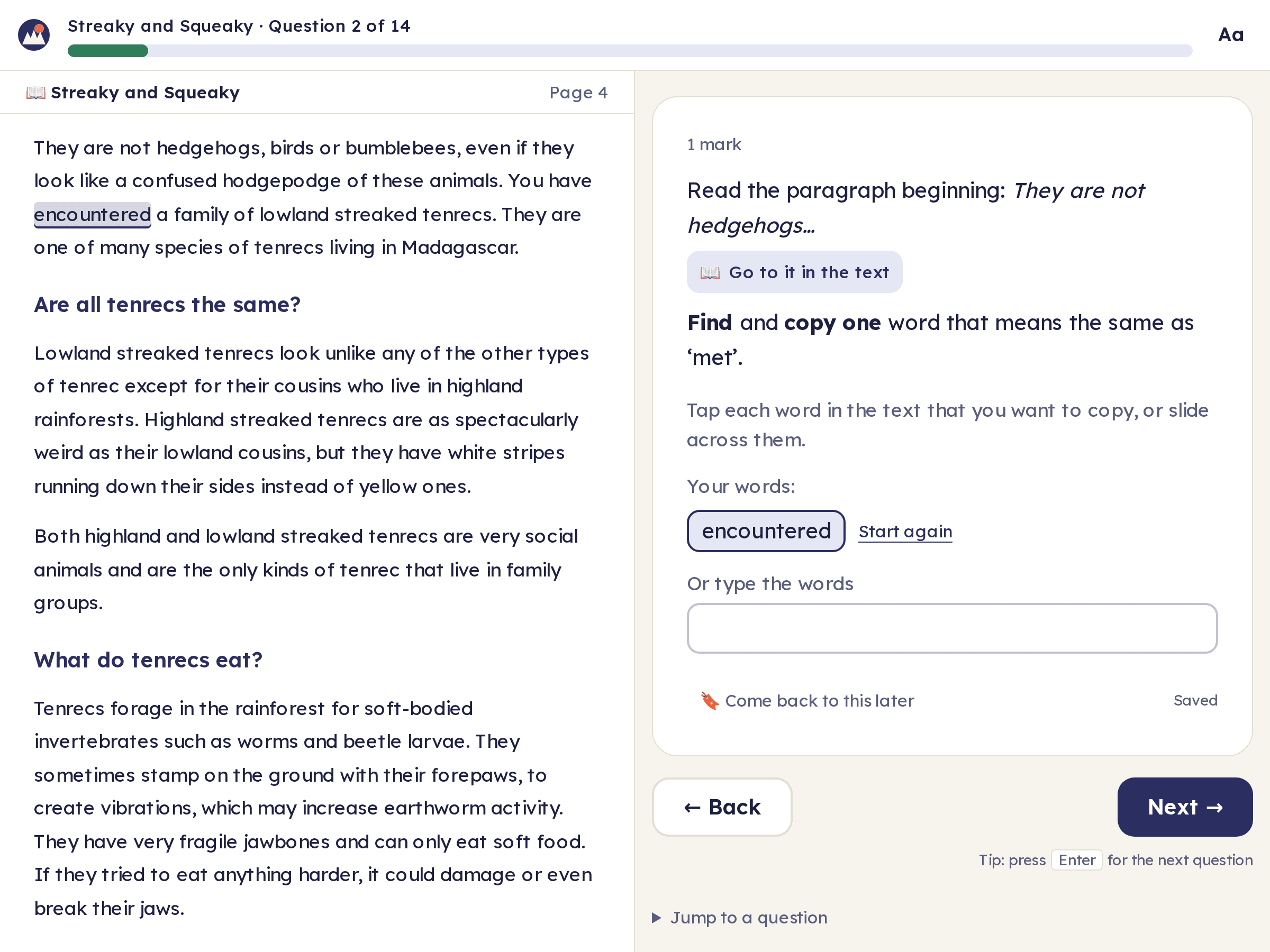
Question 2 from the 2024 reading paper, on Streaky and Squeaky, as your child sees it in the app on a laptop: the text on the left and the question on the right.
The answer
encountered. "You have encountered a family of lowland streaked tenrecs": you've met them, or come across them.
The question asks for one word, copied from the text, so words that mean much the same, such as "found" or "seen", don't get the mark. In the app, children tap the word in the text, or type it.
For your child
Read this together
Some words mean different things in different sentences. To work out what a word means here, read the whole sentence around it.
Then try your own word in its place. If the sentence still means the same thing, you've got it.
The next leg of the journey was by boat.
What does leg mean here?
Practise this
Next door to this one:
Practise every question and track your child's progress
Over 1,100 real SATs questions, each with an explanation written for an 11-year-old, and a clear view of which topics need work. Free for families.
Spotted a mistake? Tell us.