Finding information
In the test framework: 2b, retrieve and record information / identify key details from fiction and non-fiction
How KS2 reading retrieval questions work: finding facts and details in the text, the kinds of question, common mistakes, and a real SATs question.
The idea
Retrieval means finding information that the text states, and writing it down accurately. The answer is in the text, in so many words: the skill is finding it quickly and reading it exactly, rather than answering from memory or from what a child already knows.
"According to the text…" and "Using information from the text…" are the signals. A question that names a page, a section or a paragraph is saying where to look.
It's the second biggest skill in the paper, about a third of the marks every year.
How SATs asks about it
A short answer
True or false
Give two (or three)
Order or fill in a table
Tick one
Marks in the papers
Since 2016, the reading paper has given it between 13 and 21 of its 50 marks each year, about a third of them.
| Year | Marks (of 50) |
|---|---|
| 2026 | 18 |
| 2025 | 15 |
| 2024 | 19 |
| 2023 | 16 |
| 2022 | 19 |
| 2019 | 21 |
| 2018 | 13 |
| 2017 | 14 |
| 2016 | 15 |
There were no tests in 2020 or 2021. A question counts for the skill its mark scheme gives it.
Worked examples
1. True or false
The lighthouse was built in 1851. For 80 years, its keepers climbed 112 steps every night to light the lamp. In 1931 the lamp became electric, and the last keeper left in 1987.
True or false: "The lamp became electric in 1851."
- Find the word electric in the text: "In 1931 the lamp became electric."
- 1851 is when the lighthouse was built. So the statement is false.
2. The right number
How many steps did the keepers climb each night?
- The text has three numbers close together: 80, 112 and 1931.
- Read the sentence: 80 is how many years, 112 is the steps. The answer is 112.
3. Give two
Give two things the keepers did each night.
- Find the sentence about the keepers: they climbed 112 steps and lit the lamp.
- Write them as two separate points, one for each mark.
Mistakes children make
Answering from memory
After reading a text once, it's easy to answer from what you remember. Going back to the page the question names catches the detail that was misremembered.
The wrong number or year
Texts with dates and numbers often put several close together. Read the whole sentence to see what each one counts.
One point where two are asked for
"Give two" means two marks for two different points. The same point said twice in different words gets one.
Using what they know, not what the text says
If the text doesn't say it, it doesn't get the mark, even when it's true.
A real question
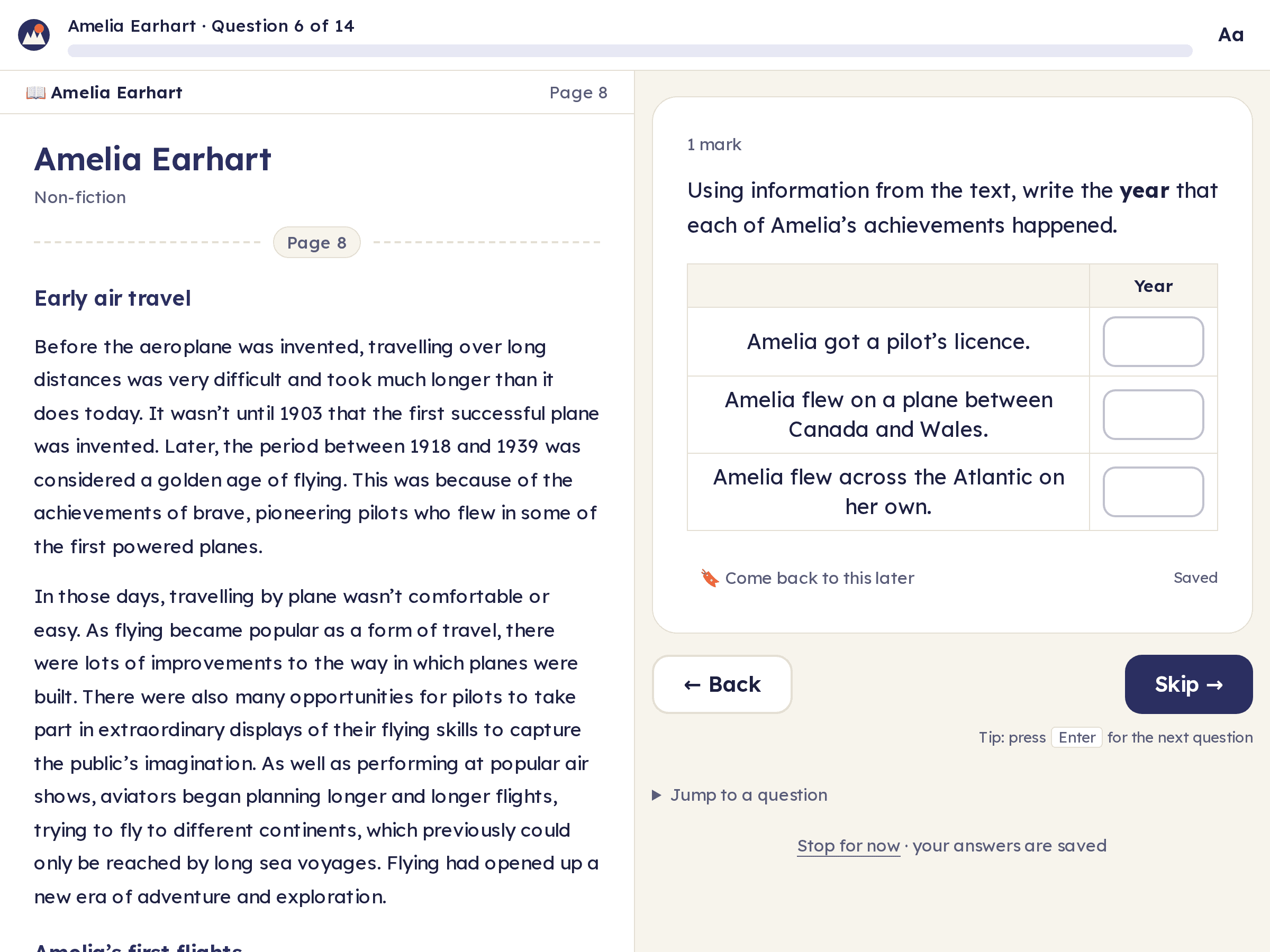
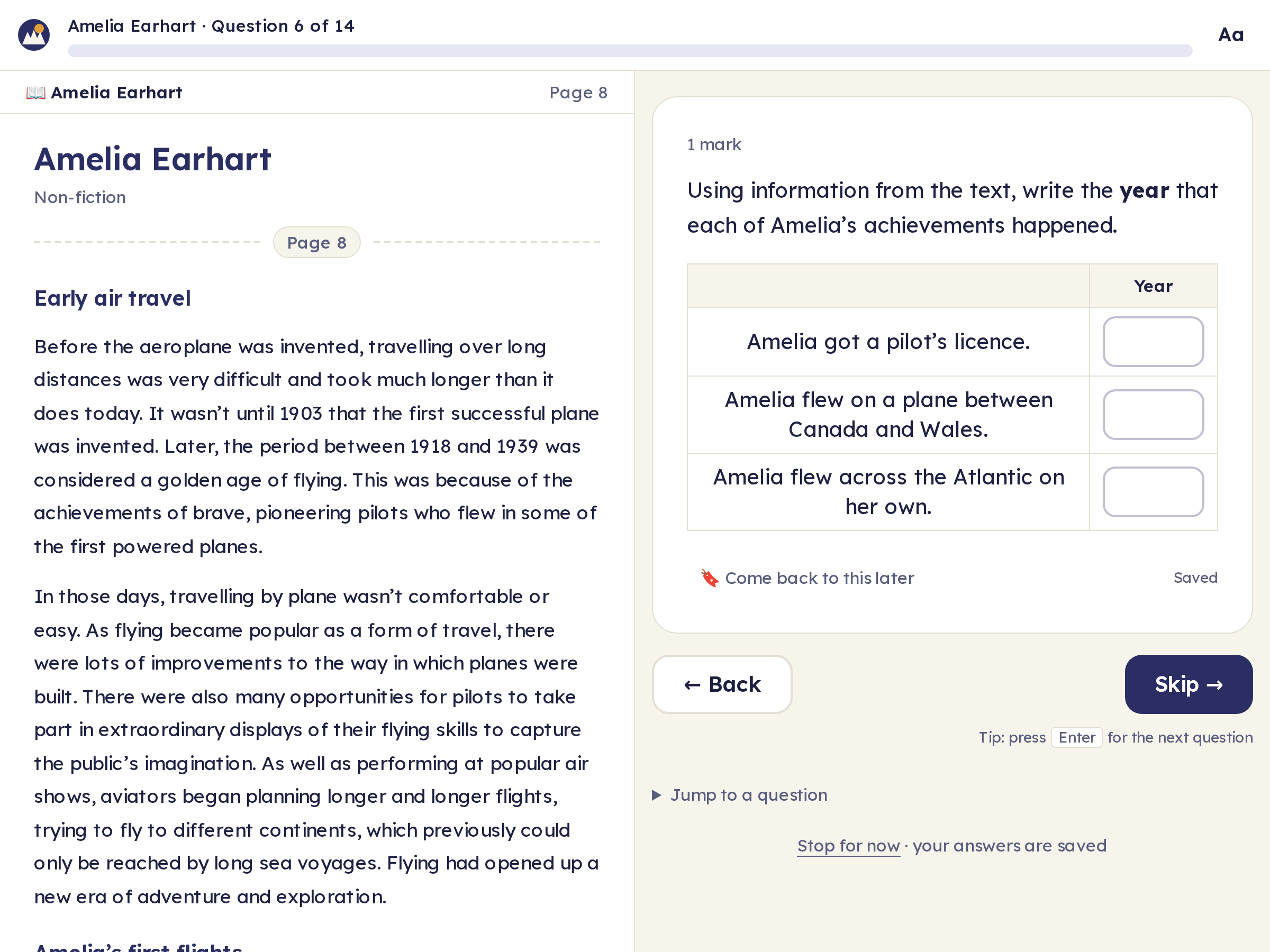
Question 30 from the 2026 reading paper, on Amelia Earhart, as your child sees it in the app on a laptop: the text on the left and the question on the right.
The answer
1923 (her pilot's licence), 1928 (Canada to Wales) and 1932 (across the Atlantic on her own). All three are needed for the mark.
The years are in different sections of the text, so this is about scanning. Watch out: in 1928 she crossed the Atlantic with two other pilots; on her own was 1932.
For your child
Read this together
For these questions, the answer is written in the text. Your job is to find it.
Look at the question's key words, like a name, a date or a number. Then go back to the text and look for those words. Read the sentence they're in carefully before you answer.
Don't answer from memory: always check the text!
Practise this
Next door to this one:
Practise every question and track your child's progress
Over 1,100 real SATs questions, each with an explanation written for an 11-year-old, and a clear view of which topics need work. Free for families.
Spotted a mistake? Tell us.