Predicting
In the test framework: 2e, predict what might happen from details stated and implied
How KS2 reading predicting questions work: saying what will happen next, backing it with clues from the text, how the marks go, and a question to try.
The idea
A prediction is a sensible guess about what will happen next, worked out from what the text has already told you. Writers plant clues: a character who packs a torch, a warning at the start, someone who "knows where we've gone". A good prediction follows those clues.
So, as with inference, an answer has two parts: the prediction (what will happen) and the evidence (the details in the text that make it likely). Any prediction the text supports can get the marks. One the text rules out can't, however exciting it is.
How SATs asks about it
What will happen next?
Tick, then explain
Tick one
Predicting is the rarest skill in the paper: since 2016 it has come up only twice, once for 3 marks and once for 1. It still needs the same habit as inference, which carries the most marks.
Marks in the papers
Since 2016, the reading paper has given it between 0 and 3 of its 50 marks each year.
| Year | Marks (of 50) |
|---|---|
| 2026 | 0 |
| 2025 | 0 |
| 2024 | 0 |
| 2023 | 0 |
| 2022 | 1 |
| 2019 | 0 |
| 2018 | 0 |
| 2017 | 0 |
| 2016 | 3 |
There were no tests in 2020 or 2021. A question counts for the skill its mark scheme gives it.
Worked examples
1. A prediction with its evidence
Priya checked the sky again. The clouds over the hill had turned the colour of slate. She looked at the washing on the line, then at her mum's car pulling away down the lane.
What do you think Priya will do next? Use evidence from the text.
- The prediction: she will bring the washing in before it rains.
- The evidence: the clouds have turned the colour of slate, which means rain is coming, she looks at the washing, and her mum has just driven away, so there's no one else to do it.
- A good answer has both: "She'll take the washing in, because dark clouds are coming and her mum has gone out."
2. Use the clues from earlier on
The best evidence is often near the start. If a story opens with a character saying "Remember, the gate must be shut or the goats get out", and ends with an open gate, the prediction almost writes itself. Look back for anything the writer took the trouble to mention.
Mistakes children make
A prediction with no evidence
When the question says "use evidence from the text", a prediction on its own gets only part of the marks. Add what made you think it: Right: She will bring the washing in, because the clouds have gone dark and her mum has driven off.
A prediction the text rules out
A surprising ending can be fun to write, but the marks go to what the text makes likely. If the characters are waiting safely for help, "they swim across" goes against the clues.
Retelling what has already happened
"The headlights flashed" is in the text already. A prediction is about what comes after the last line.
A real question
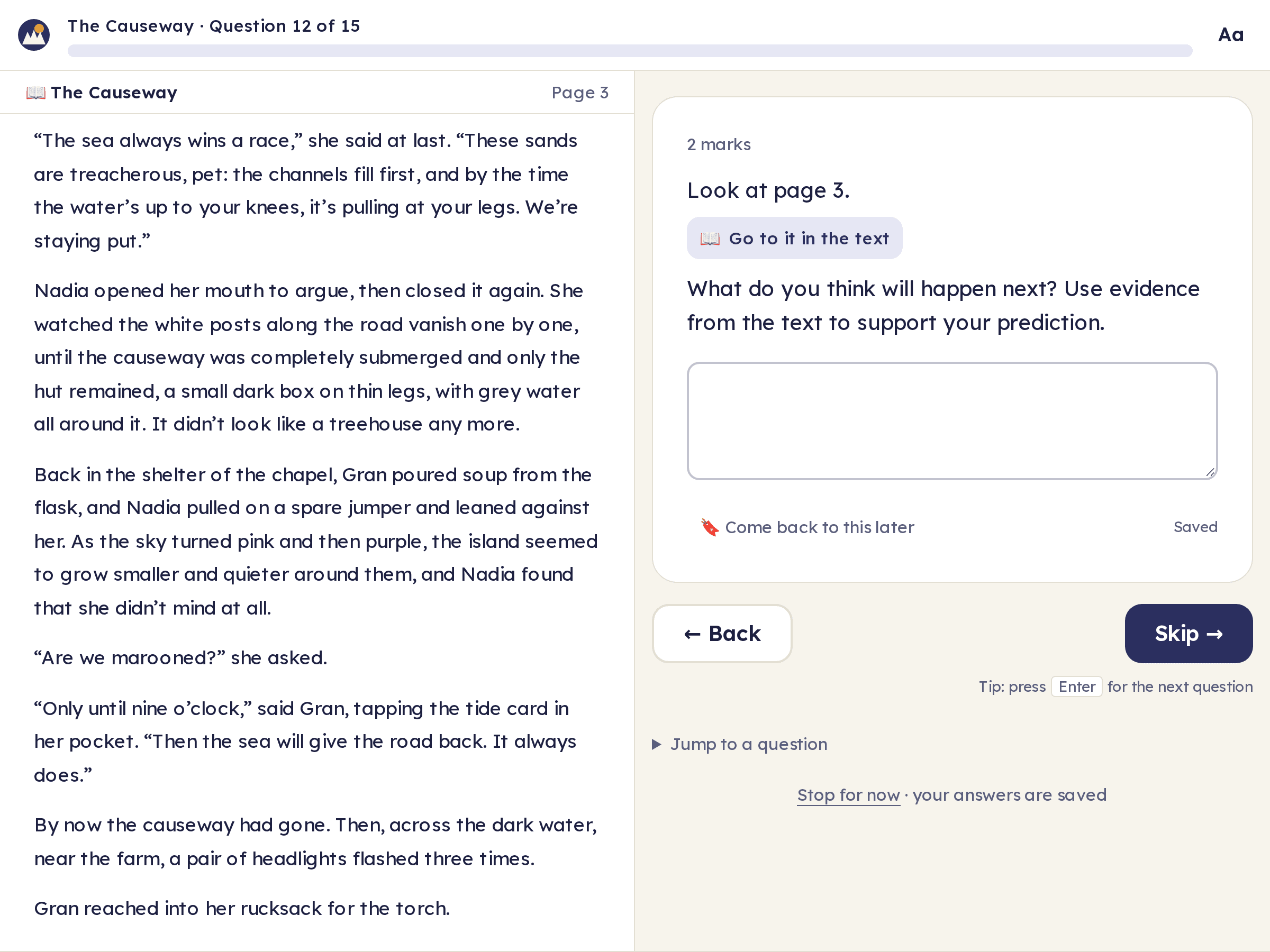
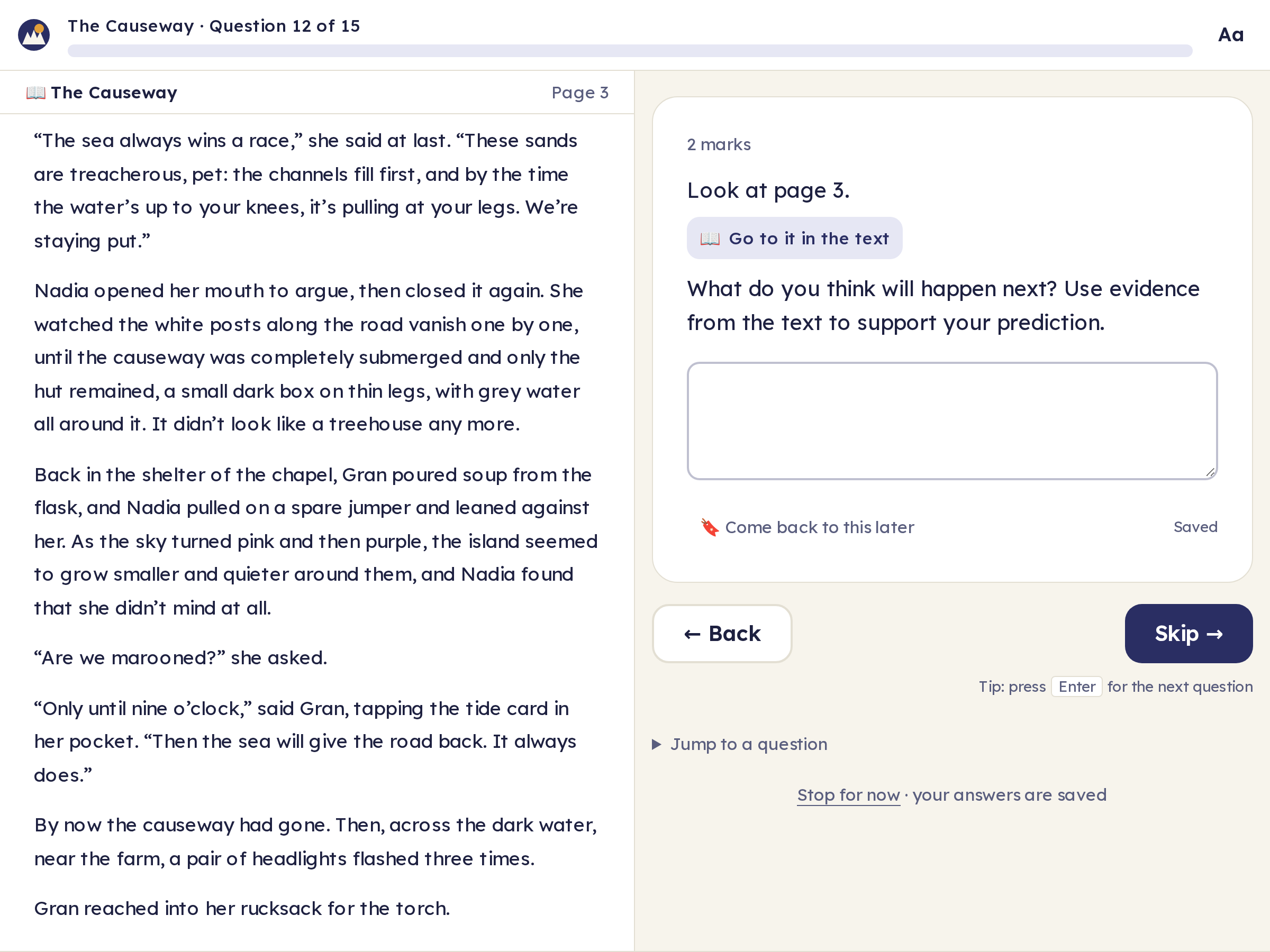
Question 12 on The Causeway, one of our own practice texts written in the style of the test's, as your child sees it in the app on a laptop: the text on the left and the question on the right.
The answer
Any prediction the story supports gets a mark, and evidence for it gets the second. For example: Gran will flash her torch back, because Alan at the farm knows where they've gone and the headlights are near the farm. Or: they'll wait until nine o'clock and walk back, because Gran says "Only until nine o'clock", when the sea will give the road back.
Watch out: "They'll run across now" or "they'll swim home" don't get the marks. The story has just shown why they won't.
For your child
Read this together
A prediction is a guess about what happens next, but a clever one. Writers leave clues, like a detective story.
When you answer, say what you think will happen, then say which words in the text gave you the idea. "Gran will flash her torch back, because she's reaching for it and Alan knows where they are."
If your guess goes against the clues, it isn't a good prediction, even if it would make a great story.
Practise this
Next door to this one:
Practise every question and track your child's progress
Over 1,100 real SATs questions, each with an explanation written for an 11-year-old, and a clear view of which topics need work. Free for families.
Spotted a mistake? Tell us.