Making inferences
In the test framework: 2d, make inferences from the text / explain and justify inferences with evidence from the text
How KS2 reading inference questions work: working out what the text doesn't say, backing it with evidence, how the marks go, and a real SATs question.
The idea
An inference is something the text shows without saying it. A character who slams a door is angry, even if the word angry is never there. Inference questions ask the child to work that out, and usually to point to the words in the text that show it: the evidence.
So most answers have two parts: the idea (she was impatient) and the evidence (she said "Come on" and hurried him along). The longer questions, worth 2 or 3 marks, ask for two or three ideas, each with its evidence.
It's the biggest skill in the paper: about two-fifths of the marks every year.
How SATs asks about it
How can you tell…?
Impressions with evidence
Why…? Explain
Tick what it suggests
Marks in the papers
Since 2016, the reading paper has given it between 18 and 24 of its 50 marks each year, about two-fifths of them.
| Year | Marks (of 50) |
|---|---|
| 2026 | 21 |
| 2025 | 24 |
| 2024 | 22 |
| 2023 | 23 |
| 2022 | 22 |
| 2019 | 18 |
| 2018 | 22 |
| 2017 | 22 |
| 2016 | 18 |
There were no tests in 2020 or 2021. A question counts for the skill its mark scheme gives it.
Worked examples
1. How can you tell?
Sam stared at the floor. When the teacher read out the scores, he folded his test paper into a tiny square and pushed it deep into his bag.
How can you tell that Sam was unhappy with his score?
- The idea: he was unhappy or embarrassed. The text never says so.
- The evidence: he folded his paper into a tiny square and pushed it deep into his bag, so no one would see it, and he stared at the floor.
- A good answer has both: "He hid his paper in his bag so no one could see his score."
2. Two impressions, with evidence
Grandma Rose was already at the gate, waving both arms, before the car had even stopped. "Come in, come in! I've baked three cakes," she said, hugging everyone twice.
Give two impressions of Grandma Rose, using evidence from the text.
- She was excited to see them: she was waiting at the gate, waving both arms, before the car stopped.
- She was generous: she had baked three cakes for them.
- Two different ideas, each with its own evidence. "Happy" and "pleased" would be the same idea twice.
Mistakes children make
An idea with no evidence
When the question says "using evidence from the text", an impression on its own can lose marks. Add the words that show it: Right: She was excited: she was waving both arms before the car had even stopped.
Evidence with no idea
Copying a quotation without saying what it shows leaves the marker to do the inferring. Say the idea first, then the words that show it.
Retelling the story
Saying what happens isn't the same as explaining what it shows. "She waved at the gate" is a fact from the text; "she couldn't wait to see them" is the inference.
The same idea twice
"Kind" and "caring" are usually one impression. Two marks need two different ideas.
A real question
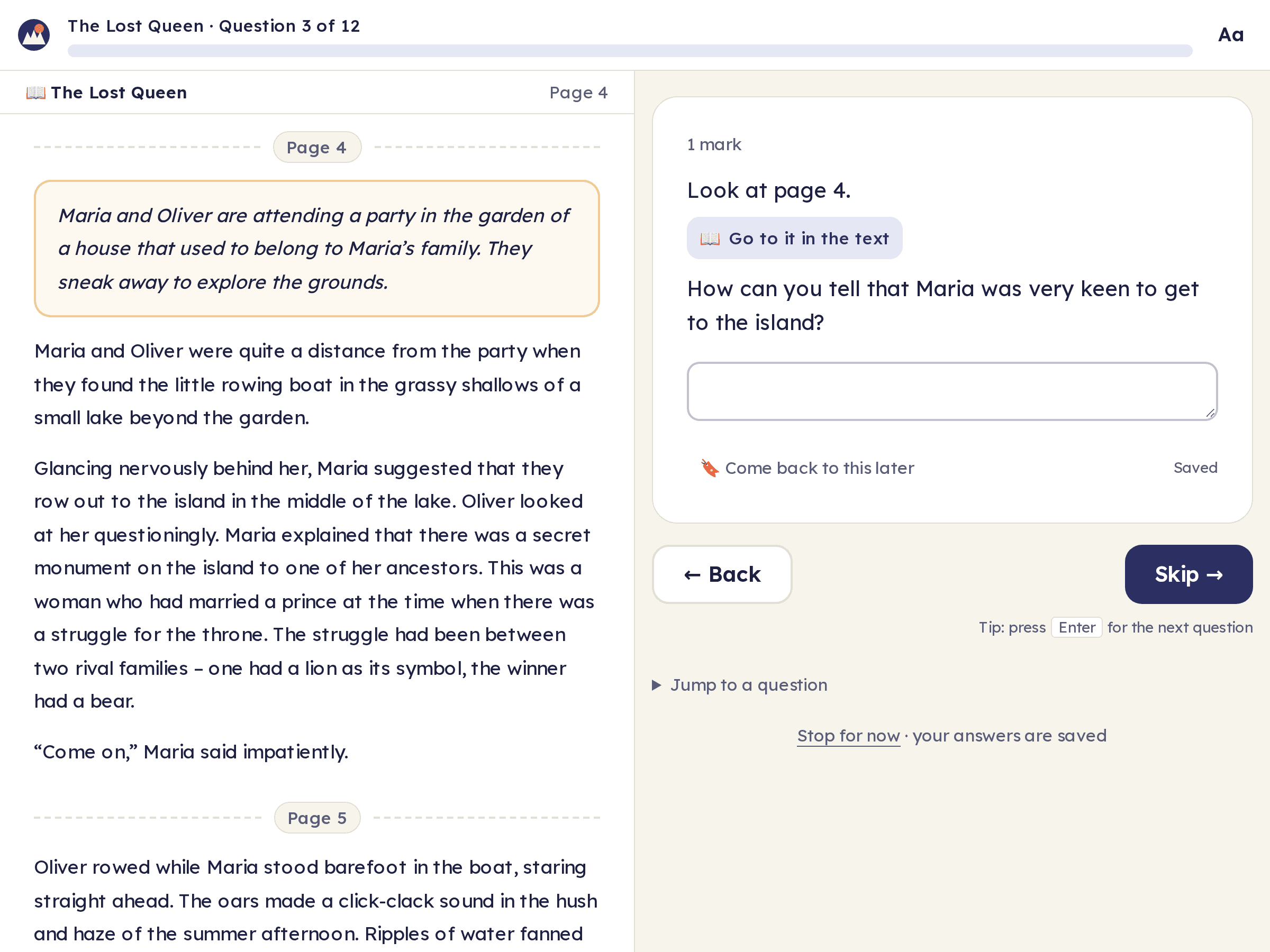
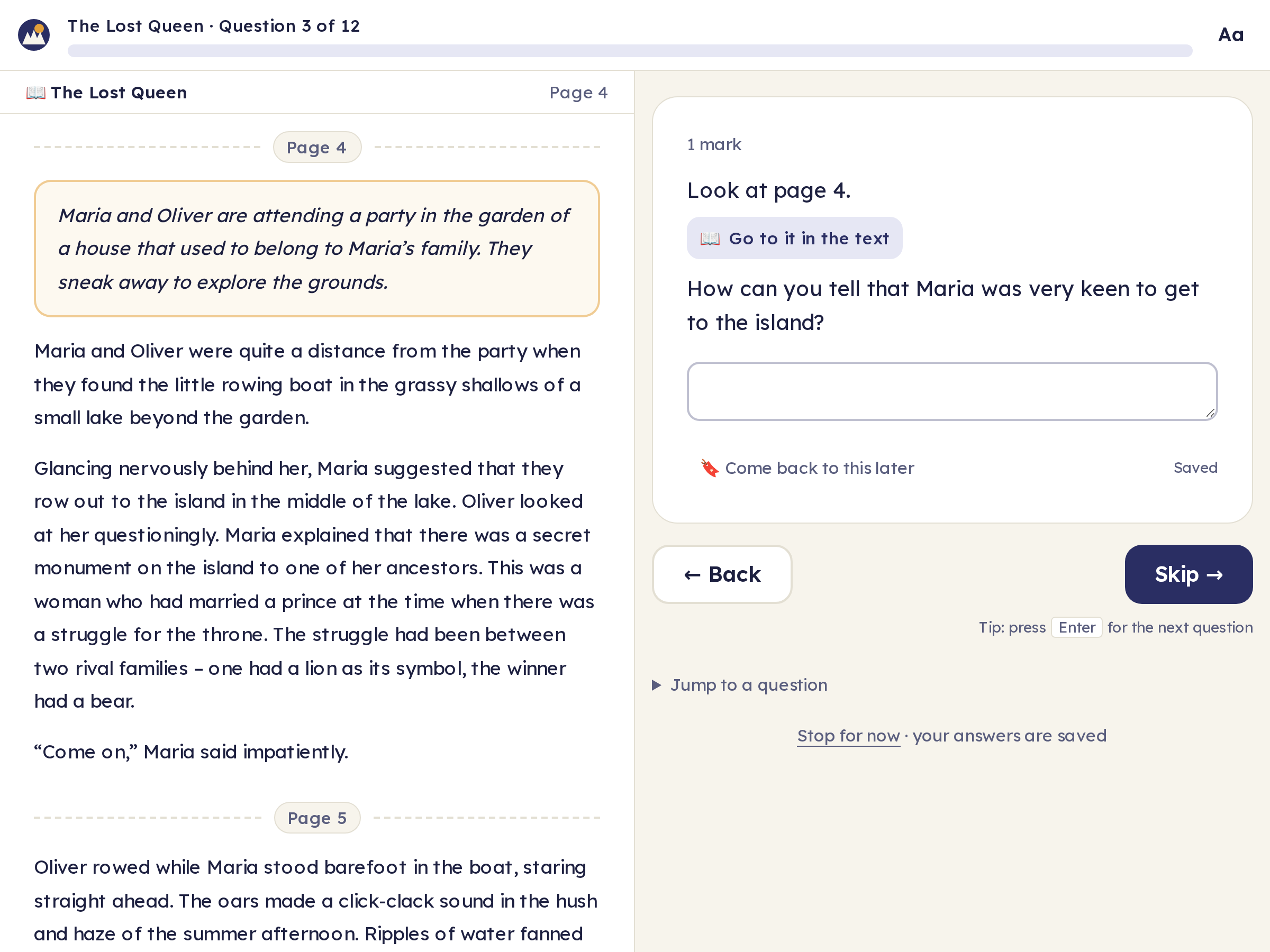
Question 3 from the 2016 reading paper, on The Lost Queen, as your child sees it in the app on a laptop: the text on the left and the question on the right.
The answer
Maria says "Come on" impatiently, hurrying Oliver along. Answers such as "she was being impatient" or "she was telling him to hurry up" get the mark.
Watch out: "She was glancing nervously behind her" doesn't. That shows she's worried about being seen, not that she's keen to get there.
For your child
Read this together
Writers don't always tell you everything. Sometimes you have to work it out, like a detective, from what the characters say and do.
When you answer, say what you worked out, then say which words in the text told you. "She was nervous, because she kept looking behind her."
Ask yourself: how do I know? The answer to that is your evidence.
Practise this
Next door to this one:
Practise every question and track your child's progress
Over 1,100 real SATs questions, each with an explanation written for an 11-year-old, and a clear view of which topics need work. Free for families.
Spotted a mistake? Tell us.