Summarising
In the test framework: 2c, summarise main ideas from more than one paragraph
How the KS2 reading test asks children to summarise: the main idea of several paragraphs or a whole text, the kinds of question, and a real SATs question.
The idea
A summary says what a part of the text is mostly about, in a few words. It has to cover the whole of that part: several paragraphs, a page, or the whole text. A true detail from one paragraph isn't a summary, however true it is.
The test usually asks children to choose the best summary from a few, so the skill is telling the main idea apart from the details around it.
How SATs asks about it
The best summary
Part of the text
Put the main events in order
Each is usually worth 1 mark, and there are only a few marks for summarising in each paper.
Marks in the papers
Since 2016, the reading paper has given it between 1 and 3 of its 50 marks each year.
| Year | Marks (of 50) |
|---|---|
| 2026 | 2 |
| 2025 | 3 |
| 2024 | 1 |
| 2023 | 1 |
| 2022 | 2 |
| 2019 | 1 |
| 2018 | 3 |
| 2017 | 2 |
| 2016 | 1 |
There were no tests in 2020 or 2021. A question counts for the skill its mark scheme gives it.
Worked examples
1. Choose the best summary
In spring, Class 6 dug two beds behind the school and planted carrots, beans and leeks. All through a hot, dry summer, they took turns to water them every morning. In October, they picked everything and cooked a huge pot of soup for the whole school.
Which is the best summary: How the school cooked soup, How a class grew vegetables from seed to soup, Why the summer was dry or How to plant carrots?
- Say what each part is about: planting, watering, picking and cooking.
- How the school cooked soup and Why the summer was dry are each only one part.
- How to plant carrots isn't what the text is about.
- How a class grew vegetables from seed to soup covers all of it.
2. Put the events in order
Number these in order: They cooked soup · They dug the beds · They watered every morning.
- Find each one in the text and note when it happened: spring, summer, October.
- So: dug the beds, watered every morning, cooked soup.
Mistakes children make
Choosing a true detail
Every option might be true. The question asks which one sums up the whole part, so check each against every paragraph.
Summing up the wrong part
"The whole of page 5" means all of it, including any boxes, not just the first paragraph.
Picking the option that copies the text's words
An option that repeats a phrase from the text can feel familiar. The best summary often uses different words from the text.
A real question
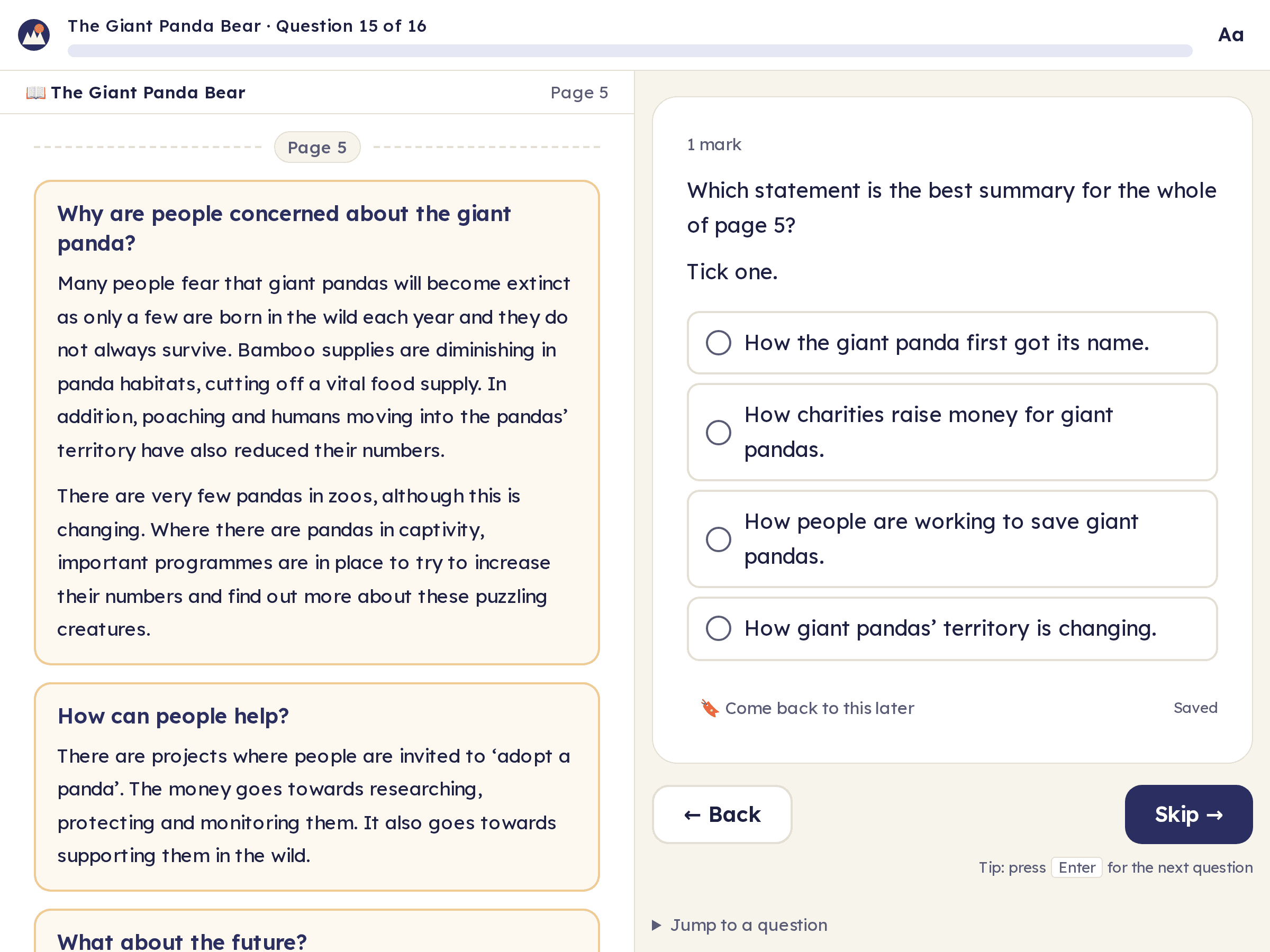
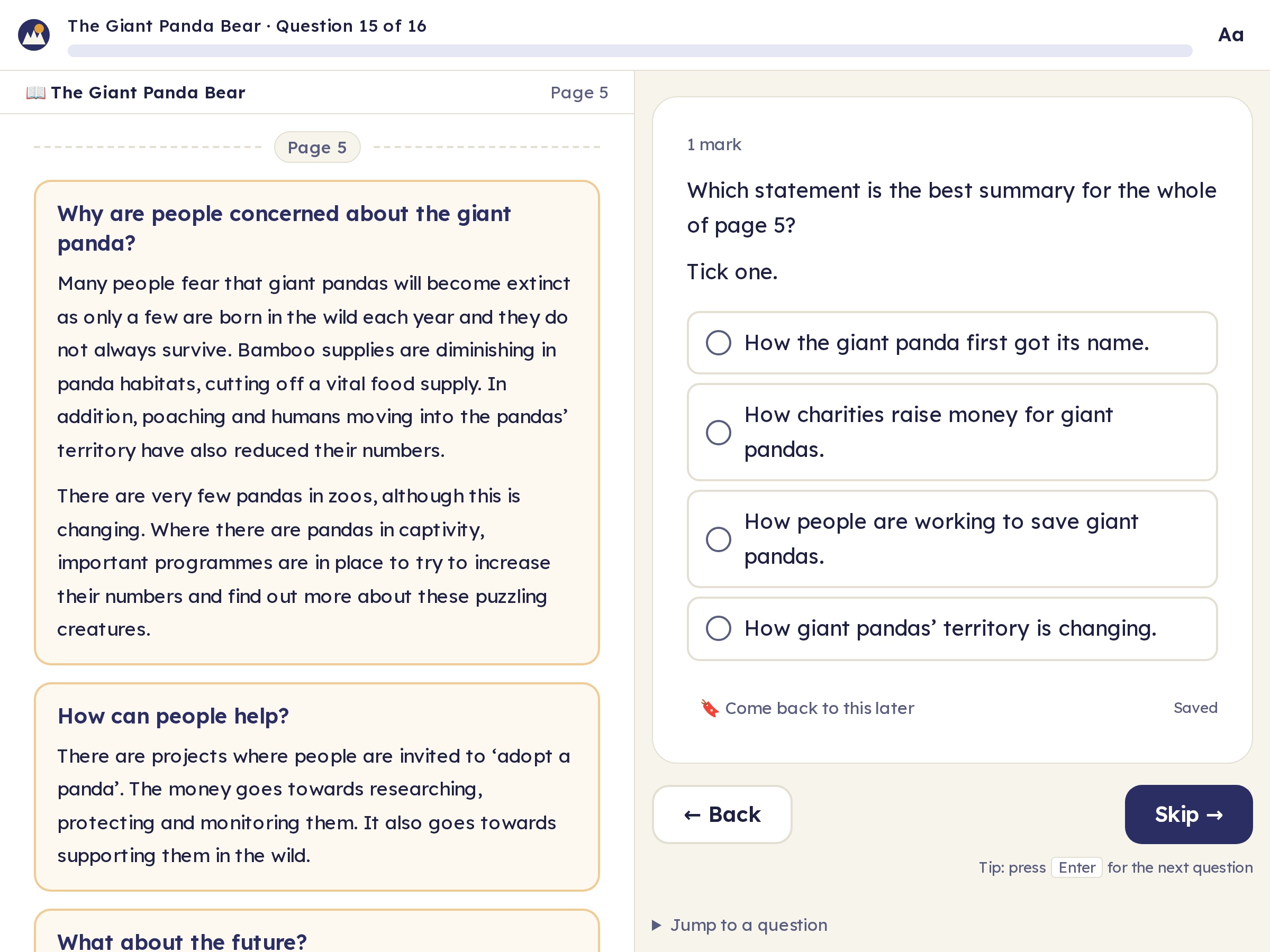
Question 14 from the 2018 reading paper, on The Giant Panda Bear, as your child sees it in the app on a laptop: the text on the left and the question on the right.
The answer
How people are working to save giant pandas. Most of page 5 is about what people are doing to help: zoos, adopting a panda and panda reserves.
The other options are each one detail from the page. The panda's old names are only in the Did you know? box.
For your child
Read this together
A summary tells you what a part of the text is mostly about, in a few words.
Before you choose, say to yourself what each paragraph is about. Then pick the answer that covers all of them, not just one.
Practise this
Next door to this one:
Practise every question and track your child's progress
Over 1,100 real SATs questions, each with an explanation written for an 11-year-old, and a clear view of which topics need work. Free for families.
Spotted a mistake? Tell us.