Word choices
In the test framework: 2g, identify / explain how meaning is enhanced through choice of words and phrases
How the KS2 reading test asks about a writer's word choices: what a word or phrase makes you think or feel, with worked examples and a real SATs question.
The idea
Words in context asks what a word means. Word choices asks what it does: the picture or feeling it gives the reader, and why the writer might have picked it. Describing a lake's surface as glassy tells you it's smooth, still and shining, without saying any of those words.
Comparisons are common here: a simile or a metaphor, such as branches like bent fingers. The answer explains what the comparison suggests, not what it literally says.
How SATs asks about it
Give impressions
What does it suggest?
What does the word tell you?
There are only a few marks for this skill in each paper, and none in some years.
Marks in the papers
Since 2016, the reading paper has given it between 0 and 3 of its 50 marks each year.
| Year | Marks (of 50) |
|---|---|
| 2026 | 2 |
| 2025 | 1 |
| 2024 | 0 |
| 2023 | 0 |
| 2022 | 0 |
| 2019 | 3 |
| 2018 | 0 |
| 2017 | 1 |
| 2016 | 2 |
There were no tests in 2020 or 2021. A question counts for the skill its mark scheme gives it.
Worked examples
1. What does the word suggest?
The wind howled around the house all night.
What does howled suggest about the wind?
- Think about what howls: wolves, or a dog in pain. It's a loud, wild sound.
- So the wind was loud and strong, and perhaps a little frightening, like an animal outside.
- Answer with what it suggests, not a definition: "It was so loud and wild it sounded like an animal."
2. Two impressions from a metaphor
By ten o'clock, the playground was a sea of coats.
Give two impressions of the playground.
- A sea is huge and covers everything, so the playground was crowded: full of children.
- A sea moves, so the children were moving about, like waves.
- Two different impressions, one for each mark.
Mistakes children make
Taking it literally
Say what the words make you picture, not what they'd mean word for word: Right: The water was smooth and shiny, like glass.
Saying it describes it
"It makes it more interesting" or "it describes the water" could be said of any word. Say what it makes you think or feel.
One impression twice
"Calm" and "peaceful" are one impression. For two marks, give two different ones: still, and shiny.
A real question
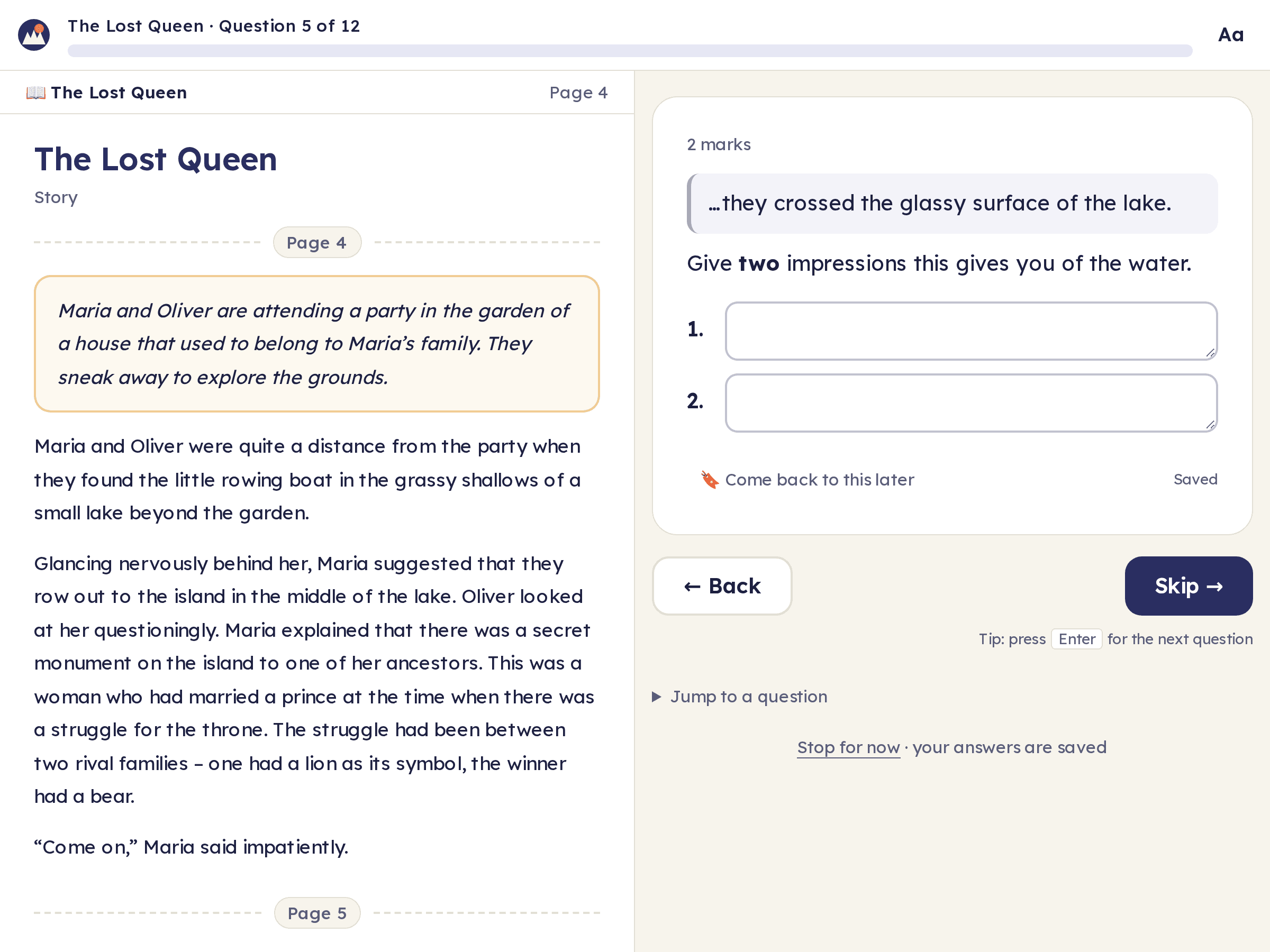
Question 5 from the 2016 reading paper, on The Lost Queen, as your child sees it in the app on a laptop: the text on the left and the question on the right.
The answer
Any two of these, a mark each: the water is shiny or reflective, like a mirror; it's clear, so you can see through it; it's still or calm; it's flat or smooth.
Think about what glass is like. Answers that take it literally ("it was made of glass"), or don't come from the word at all ("cold", "deep"), get no marks.
For your child
Read this together
Writers choose their words carefully, to help you picture things.
When a question asks about a word, close your eyes and imagine it. What does it make you see, hear or feel? That's your answer.
The wind howled around the house.
What picture does howled give you?
Practise this
Next door to this one:
Practise every question and track your child's progress
Over 1,100 real SATs questions, each with an explanation written for an 11-year-old, and a clear view of which topics need work. Free for families.
Spotted a mistake? Tell us.